
Question bank

2,000+ questions in the full question bank

Explore six 2026 samples from RI, HCI and ASRJC below.

Preview
Section
Topic
Question type (subtopic)
School
Year
Paper type

More schools, years and subtopic filters are locked in this preview.

6 sample questions

RI · 2026 · Prelims · Paper 1

Question 3

Part (a) · Find a related rate from a volume function

Part (b) · Link related rates using implicit differentiation
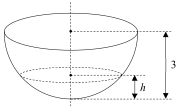
Original hemisphere diagram for RI 2026 Paper 1 Question 3

Water is poured at a rate of 0.5 m30.5\ \mathrm{m}^3 per minute into an empty container in the form of an open hemisphere with inside radius 3 m3\ \mathrm{m} (see diagram). At time tt minutes after the start, the radius of the water surface is r mr\ \mathrm{m} and the volume of the water in the hemispherical container is 13πh2(9−h)\dfrac{1}{3}\pi h^2(9-h), where h mh\ \mathrm{m} is the depth of the water. When the depth of the water is 1 m1\ \mathrm{m},

(a)

find the rate of change of the depth of water,

[3]
(b)

find the rate of change of the radius of the water surface.

[3]

HCI · 2026 · Prelims · Paper 2

Question 8

Part (a) · Draw a scatter plot and interpret correlation

Part (b) · Justify the direction of a regression line

Part (c) · Identify an outlier in a scatter plot

Part (d) · Fit a regression line and calculate correlation

Part (e) · Extrapolate using regression and assess reliability

A biologist is investigating the relationship between the light intensity level, xx (in arbitrary units), and the growth rate, yy (in mm/month), of a coral species. Samples of this coral species are placed in a controlled environment and exposed to 10 different light intensity levels for a fixed period. The growth rates of the samples are measured. The results are shown in the table below.

Light intensity level and coral growth rate
xx12345678910
yy4.06.29.413.27.815.018.021.123.028.0
Light intensity level and coral growth rate, paired values
xxyy
14.0
26.2
39.4
413.2
57.8
615.0
718.0
821.1
923.0
1028.0

The product moment correlation coefficient between xx and yy is 0.960, correct to 3 significant figures.

(a)

Draw the scatter diagram for these values, labelling the axes clearly. What do the scatter diagram and product moment correlation coefficient suggest about the relationship between the light intensity level and growth rate? Justify your answer.

[3]
(b)

The biologist wishes to find the light intensity level required to achieve a target coral growth rate of 25 mm/month. Suggest, in the context of the question, why the regression line of yy on xx should be used for this purpose.

[2]
(c)

The biologist checks the results and one of the values of yy appears to be an outlier. Indicate the corresponding point on your diagram in part (a) by labelling it PP.

[1]

Omit PP for the rest of the question.

(d)

Use your calculator to find the equation of the least squares regression line suggested in part (b). State the value of the product moment correlation coefficient.

[3]
(e)

Use the equation of the least squares regression line to estimate the growth rate of the coral species when the light intensity level is 12. Explain whether you would expect this estimate to be reliable.

[2]

ASRJC · 2026 · Paper 1

Question 1

Question 1 · Recover a function by reversing graph transformations

A graph with equation y=f(x)y=\mathrm{f}(x) undergoes, in succession, the following transformations:

I:

A translation of 3 units in the negative yy-direction;

II:

A translation of 1 unit in the negative xx-direction;

III:

A scale parallel to the xx-axis by a scale factor of 12\dfrac{1}{2};

IV:

A reflection in the yy-axis.

The equation of the resulting curve is y=ln⁡(2−4x)−2y=\ln(2-4x)-2.

Determine the equation of function f\mathrm{f}, showing your workings clearly.

[4]

RI · 2026 · Prelims · Paper 1

Question 1

Question 1 · Determine parametric coefficients from stationary points

A curve has parametric equations

x=t2+1,y=at3+bt2+ct,x=t^2+1,\qquad y=at^3+bt^2+ct,

where t>−2t>-2 and aa, bb and cc are constants.

The curve has stationary points at t=−1t=-1 and t=2t=2. Given that the curve passes through the point (5,−2)(5,-2), find the values of aa, bb and cc.

[4]

HCI · 2026 · Prelims · Paper 2

Question 1

Part (a)(i) · Determine a parameter from an oblique asymptote

Part (a)(ii) · Sketch a rational curve and its key features

Part (a)(iii) · Determine when a circle and curve do not intersect

Part (b) · Track coordinates through successive graph transformations

(a)

The curve CC has equation y=kx2−kx+68x−2y=\dfrac{kx^2-kx+68}{x-2}, where kk is a constant.

(i)

If the equation of the oblique asymptote of CC is y=2x+2y=2x+2, state the value of kk.

[1]

Use the value of kk found in part (a)(i) for the rest of the question.

(ii)

Sketch CC, showing clearly the coordinates of any axial intercepts and stationary points, and the equations of any asymptotes.

[3]
(iii)

Find the range of values of rr, where r>0r>0, such that the equation (x−8)2+(kx2−kx+68x−2−10)2=r2(x-8)^2+\left(\dfrac{kx^2-kx+68}{x-2}-10\right)^2=r^2 has no real solutions for xx.

[2]
(b)

The graph of y=f(x)y=f(x) is transformed onto the graph of y=g(x)y=g(x) in a sequence of three transformations. The graph of y=f(x)y=f(x) is first transformed onto the graph of y=f(x)+1y=f(x)+1, followed by a reflection in the xx-axis and is finally transformed onto the graph of y=g(x)y=g(x) by transformation TT. A point PP with coordinates (a,b)(a,b) lies on the graph of y=f(x)y=f(x). PP is mapped onto a point QQ with coordinates (a−1,m)(a-1,m) where QQ lies on the graph of y=g(x)y=g(x). Find mm in terms of bb and describe TT.

[3]

ASRJC · 2026 · Paper 1

Question 5

Part (a) · Evaluate a definite integral with a modulus

Part (b)(i) · Verify a logarithmic–trigonometric derivative

Part (b)(ii) · Integrate by parts and rearrange a recurring integral

(a)

Find the exact value of ∫−12∣e−x−x−1∣ dx\displaystyle\int_{-1}^{2}|\mathrm{e}^{-x}-x-1|\,\mathrm{d}x. Show your workings clearly.

[3]
(b)(i)

Show that ddx[ln⁡(sec⁡x+tan⁡x)]=sec⁡x\dfrac{\mathrm{d}}{\mathrm{d}x}\left[\ln(\sec x+\tan x)\right]=\sec x for 0<x<π20<x<\dfrac{\pi}{2}.

[1]
(ii)

Hence, using integration, show that

∫sec⁡3x dx=12(sec⁡xtan⁡x+ln⁡(sec⁡x+tan⁡x))+C\displaystyle\int\sec^3x\,\mathrm{d}x=\dfrac{1}{2}\bigl(\sec x\tan x+\allowbreak\ln(\sec x+\tan x)\bigr)\allowbreak+C for 0<x<π20<x<\dfrac{\pi}{2}.

[3]

Ask your tutor

Contact Sterling on WhatsApp about this question. Your question reference will be included.

Open WhatsApp

WhatsApp opens with a message for you to review. You choose whether to send it.